Everything Foreign Travelers Need to Know Before Arriving in China
The first thing many travelers notice after landing in China isn’t the skyline, the food, or even the culture—it’s how incredibly digital daily life has become.
A few years ago, visiting China often meant carrying cash, printing hotel reservations, and struggling to communicate with taxi drivers. Today, almost everything happens through a smartphone. You can order food, call a taxi, pay for coffee, navigate subway systems, translate menus, and even enter tourist attractions without ever opening your wallet.

For many international visitors, this level of digital convenience is exciting—but also slightly intimidating. Questions like “Will my credit card work?”, “How do I get internet access?”, or “Can foreigners use WeChat Pay?” are among the most searched topics before a trip to China.
The good news is that traveling in China has become much easier for foreign visitors than ever before. This guide covers everything you need to know about internet access, ride-hailing apps, mobile payments, maps, and essential digital tools for a smooth journey across China.
Why Your Smartphone Is More Important Than Your Passport
China’s tourism infrastructure is modern, efficient, and heavily app-based.
Whether you’re exploring Beijing’s imperial palaces, wandering through Shanghai’s futuristic skyline, tasting street food in Chengdu, or hiking among the sandstone pillars of Zhangjiajie, your phone will likely become your primary travel companion.
Before your trip, make sure your device is:
- Unlocked for international SIM or eSIM use
- Updated to the latest operating system
- Able to receive international SMS verification codes
- Equipped with a portable power bank
A fully charged smartphone can effectively replace cash, guidebooks, metro tickets, and even language phrasebooks.
How to Get Internet Access in China
Option 1: Buy an eSIM Before You Fly
For most travelers, an eSIM is the easiest solution.
Benefits include:
- Instant activation
- No physical SIM card required
- Internet available immediately upon landing
- Easy online purchase before departure
Popular providers usually offer:
- 5GB–20GB data packages
- Coverage across mainland China
- Hotspot sharing support
For short trips under two weeks, a 10GB package is typically sufficient.
Option 2: Purchase a Local SIM Card
If you plan to stay longer than two weeks, a local SIM card may provide better value.
Major telecom providers include:
- China Mobile
- China Unicom
- China Telecom
Many international airports now have service counters where foreigners can purchase SIM cards using their passports.
Option 3: Hotel Wi-Fi
Most hotels, cafes, airports, and shopping malls provide free Wi-Fi.
However, public Wi-Fi often requires SMS verification. Having a local number or eSIM can make the process much easier.
Can Foreigners Use Mobile Payments in China?
Absolutely.
This is one of the biggest changes that has made traveling in China easier for international visitors.
WeChat Pay
Foreign travelers can now link:
- Visa
- Mastercard
- JCB
- Discover
- Diners Club
directly to WeChat Pay.
Once linked, you can pay for:
- Restaurants
- Metro rides
- Convenience stores
- Tourist attractions
- Ride-hailing services
Alipay
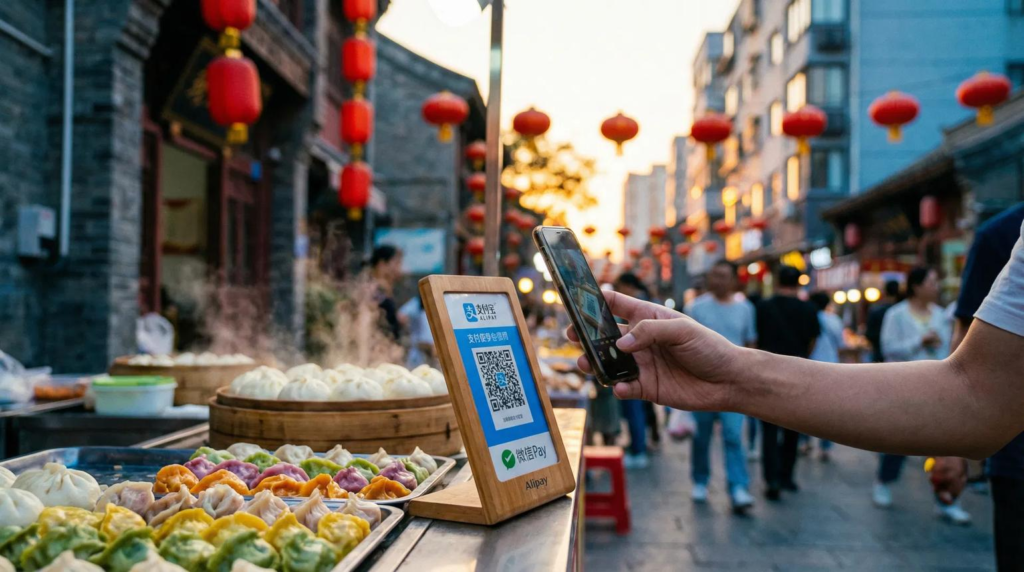
Alipay is equally popular and often slightly easier for first-time visitors.
Many travelers report that Alipay’s English interface is more intuitive.
With Alipay you can:
- Scan QR codes for payments
- Book taxis
- Purchase train tickets
- Access city transportation services
In major cities, you’ll rarely need physical cash.
Should You Still Carry Cash?
Yes—but only a small amount.
While mobile payments dominate daily life, carrying 200–500 RMB can be useful for:
- Rural areas
- Small local markets
- Temporary technical issues
- Emergency situations
Most travelers find themselves using cash only once or twice during an entire trip.
How to Get a Taxi in China
Use DiDi Instead of Street Taxis
Think of DiDi as China’s version of Uber.
Advantages include:
- English-language interface
- Transparent pricing
- GPS tracking
- Digital payments
- Driver information displayed in advance
You can access DiDi directly inside:
- Alipay
No separate app download is always required.
Taxi Tips for Foreign Travelers
Before leaving your hotel:
- Save your destination in Chinese
- Screenshot the address
- Keep your hotel’s business card
This can be extremely helpful if the driver does not speak English.
The Best Navigation Apps for China
Apple Maps
Surprisingly, Apple Maps works very well in China.
Many foreign travelers find it accurate and easy to use.
Amap (Gaode Maps)
China’s most widely used navigation platform.
Features:
- Real-time traffic updates
- Walking routes
- Public transportation planning
- Taxi booking integration
English support continues to improve.
Baidu Maps
Another powerful navigation tool.
Particularly useful for:
- Local businesses
- Detailed city information
- Public transit planning
Taking China’s High-Speed Trains
China operates the world’s largest high-speed rail network.
Travelers can easily move between:
- Beijing
- Xi’an
- Shanghai
- Chengdu
- Chongqing
- Guilin
- Guangzhou
at speeds exceeding 300 km/h.
Booking Tickets
Popular options include:
- Railway 12306 App
- Trip.com
Trip.com is generally more foreigner-friendly and supports international credit cards.
Translation Apps You Should Download
Language barriers are much smaller today thanks to AI translation.
Recommended tools:
- Google Translate
- Microsoft Translator
- DeepL
- WeChat Translation
Features such as camera translation can instantly translate:
- Menus
- Street signs
- Museum information
- Train station notices
Essential Apps for Traveling in China
Before your flight, install:
| App | Purpose |
|---|---|
| Messaging & Payments | |
| Alipay | Payments & Travel Services |
| DiDi | Taxi Booking |
| Trip.com | Hotels & Transportation |
| Amap | Navigation |
| Google Translate | Language Assistance |
These six apps cover nearly every aspect of a China trip.
Safety and Convenience: What Surprises Most Foreign Visitors?
Many travelers arrive expecting cultural differences but leave impressed by something else entirely—the efficiency.
Ordering dinner, finding transportation, navigating cities, and paying for services often takes just a few taps.
China’s combination of advanced digital infrastructure, extensive transportation networks, and increasingly foreign-friendly payment systems has transformed the visitor experience. Even first-time travelers who speak little or no Chinese often find themselves comfortably exploring the country within a day or two of arrival.
The biggest mistake many visitors make is over-preparing for challenges that no longer exist. Modern China is easier to navigate than most people imagine. With internet access, mobile payment apps, and a handful of practical tools installed before departure, you’ll spend less time figuring things out and more time enjoying ancient temples, vibrant cities, mountain landscapes, local cuisine, and unforgettable cultural experiences.
Whether you’re planning your first China adventure or returning after many years away, you’ll likely discover a country that feels both deeply historic and remarkably connected—a place where centuries-old traditions coexist seamlessly with some of the world’s most advanced travel technology.


发表回复